
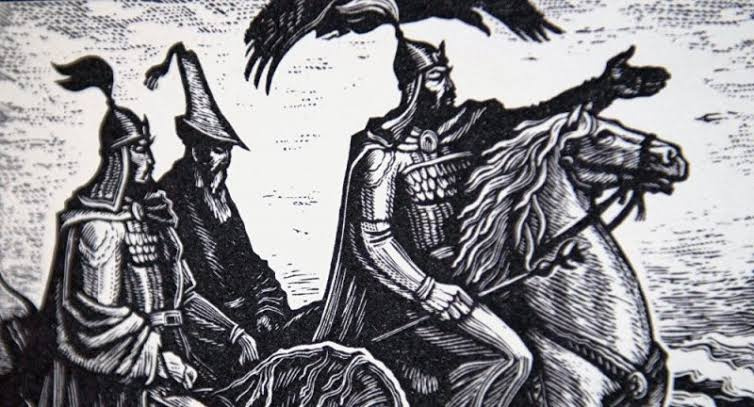
Manas is the great epic of the Kyrgyz people and one of the longest poems ever recorded — the longest versions run to hundreds of thousands of lines, many times longer than the Iliad and the Odyssey together. For centuries it was never written down: it lived only in the memory of storytellers.
The 19th-century Kazakh scholar Chokan Valikhanov called it an encyclopedia of Kyrgyz life — myths, tales and history gathered around one hero, together with the customs, geography, beliefs and medicine of the people.
In 2013 UNESCO added the Kyrgyz epic trilogy — Manas, Semetey, Seitek — to its list of the Intangible Cultural Heritage of Humanity.
The manaschi
The epic is kept alive by manaschi — storytellers who recite it from memory, without music, with powerful voice, gestures and facial expressions. A great manaschi can perform for hours, even days, and is believed to receive the gift in a dream. Because every storyteller tells it in his own way, there is no single ‘official’ text: dozens of versions have been recorded. The two most famous were dictated by Sagymbai Orozbakov and Sayakbai Karalaev in the 20th century.
In 1995 Kyrgyzstan and UNESCO celebrated the 1,000th anniversary of the epic. Today children learn Manas at school, and you can hear manaschi perform at festivals, in theatres and at the Manas Ordo complex in Talas.
The story in brief
Part one: Manas
After the death of the Kyrgyz khan Nogoi, enemies seize the Kyrgyz homeland and drive the people away. Nogoi’s son Jakyp lives in exile in the Altai mountains, rich in cattle but without an heir. After years of prayers a son is born — on the same day as a foal that is promised to him. The boy is named Manas.
Manas grows up stronger and bolder than any other child. When enemy spies come to capture him, he and his friends take the whole caravan and share the goods among the poor. He defeats the army sent against him, the tribes unite under him, and he is chosen khan. With his forty warriors — the kyrk choro — his loyal horse Ak-Kula and his friends Bakai, Koshoi and the wise warrior Almambet, he leads the Kyrgyz back to their homeland in the Ala-Too mountains.
Manas marries the wise Kanykei, his adviser and support. He survives poisoning by jealous relatives and the plots of rival khans. Finally he leads the great campaign, the Chong Kazat, against the Kyrgyz enemies in the east. The Kyrgyz win, but many heroes fall — among them Almambet — and Manas himself is wounded by a treacherous spear while praying. He returns home and dies. Kanykei builds a mausoleum (gumbez) for him.
Part two: Semetey
After Manas’s death his half-brothers take power and threaten his baby son. Kanykei flees with the child to her own people. Semetey grows up without knowing who his father was. At sixteen he learns the truth, returns to Talas, punishes the traitors, marries Aichurek — promised to him before he was born — and avenges his father. In the end he too is betrayed by a companion. Semetey is the most often performed part of the trilogy.
Part three: Seitek
Manas’s grandson Seitek is raised in the camp of his father’s enemies. When he discovers his origin, he drives out the traitors, brings his people together and restores peace. The whole trilogy carries one idea: unity of the people, and freedom from enemies outside and within.
Manas in Kyrgyzstan today
- Manas Ordo in the Talas valley — a museum complex around the 14th-century mausoleum that legend calls the tomb of Manas. (The inscription on it actually names a noble woman, Kenizek-Khatun; according to legend, Kanykei did this to hide the hero’s grave from his enemies.)
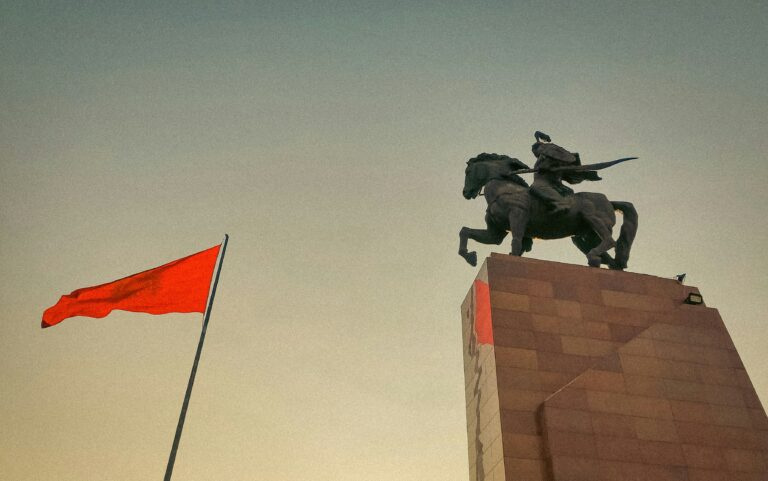
- Bishkek’s international airport, the national university and a great many streets are named after Manas, and his statue stands in Ala-Too Square.
- Images from the epic — the forty warriors, Ak-Kula, Kanykei — appear on banknotes, in paintings, theatre and film.
Want to hear a manaschi? Ask us — we can arrange a short performance during a tour. Read on: Nomad games — many of them appear in the epic — and a short history of Kyrgyzstan.