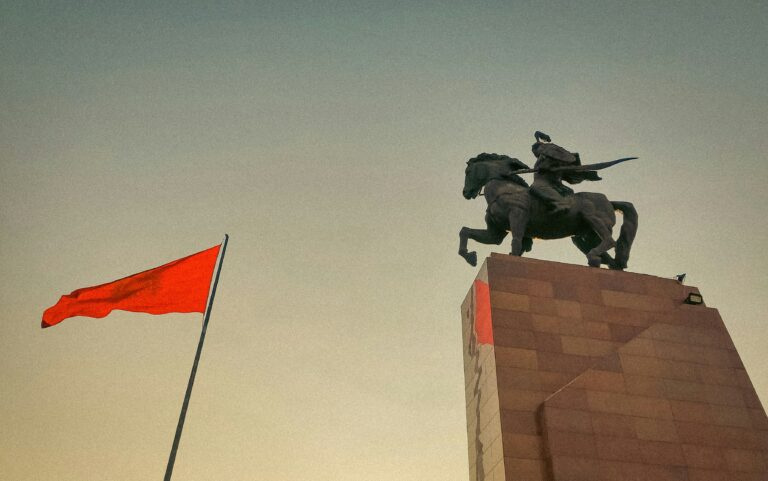

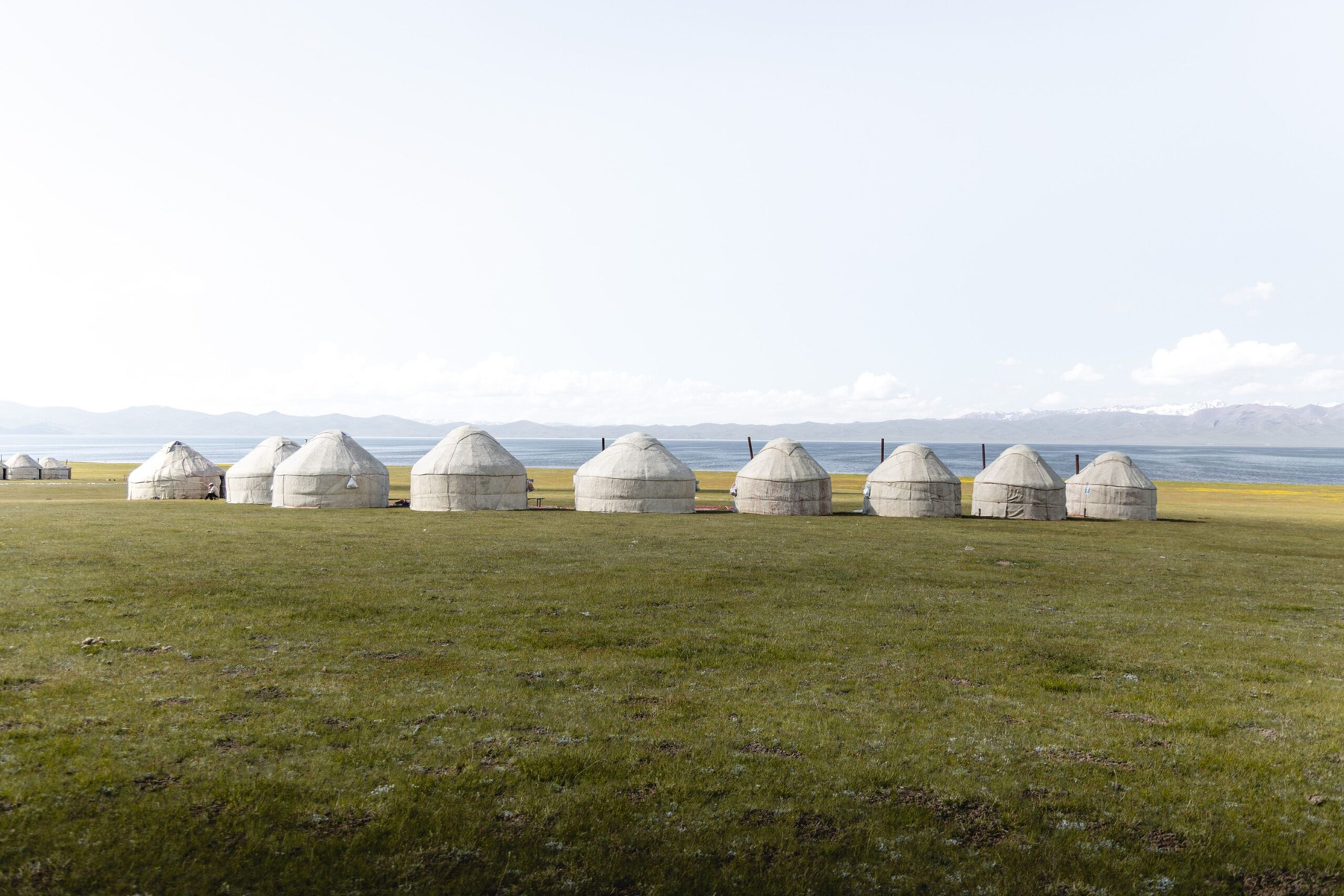
The yurt is the symbol of Kyrgyz life. For centuries it was a portable home that could be taken down, loaded onto a camel, horse or yak, and put up again on the next pasture. Its crown — the round wooden tunduk — sits in the centre of the red national flag, and in the old days a khan could count his subjects by counting the smoke rising from the tunduks. Villages still count households as tutun, “smokes”.
Even today, city families put up a yurt in the courtyard for the most important moments of life: the birth of a child, a wedding or a funeral.
The grey house
The Kyrgyz call the yurt boz uy — the grey house. Ordinary families used felt made from grey and black wool, while khans lived in yurts covered in snow-white felt, called ak orgo. Wealth was measured by size: a big yurt had more wall sections and more ropes. An average family yurt is about 5 metres across and 3 metres high.
A skilled master builds a yurt in about a month, and with care it lasts for decades. It is put together without a single nail. A family needs 130–170 kg of wool for the felt alone — the wool of a whole flock.
How a yurt is put up
- First the wooden door frame is set up and the door hung.
- Then the kerege — folding lattice walls — are opened out in a circle and tied to the frame.
- The tunduk is lifted into place and joined to the walls with long curved poles, the uuk.
- The walls are wrapped in mats of chiy (steppe grass woven with coloured wool), then the whole frame is covered with felt and tied down with woven and embroidered bands.
An experienced family needs about an hour. The felt keeps the yurt warm on frosty nights and cool on hot days; the flap over the tunduk is opened or closed to control light and smoke.
Inside: everyone has a place
The hearth, kolomto, burns in the centre under the tunduk. Fire was believed to purify, so people never spat into it, poured water on it or stepped over it.
- Tor — the place of honour opposite the door. Here sit guests and elders (aksakals); in daily life it belongs to the head of the family. Behind it, chests are piled with blankets, carpets and furs — a display of the family’s wealth.
- The women’s side holds food, dishes and the kitchen. Embroidered bags hang on the walls with needles, thread and small treasures.
- The men’s side holds saddles, harness and hunting gear.
- Children and younger family members sit nearer the door.
The floor is covered with felt carpets — shyrdak and ala-kiyiz — and the walls with embroidered panels, tush-kiyiz. They keep the warmth in and turn a simple tent into a beautiful home.
Customs of the yurt
- A family that set up a new yurt held a housewarming feast, uy toi.
- Nobody spoke badly of a yurt; the masters who made them — uichu and usta — and the women who made the felt were highly respected.
- By tradition the youngest son stays with his parents and inherits the family yurt, while older brothers receive a yurt of their own when they marry.
- When someone dies, the family puts up a yurt next to the house where people come to mourn and pay respects.
A day in a herder’s yurt
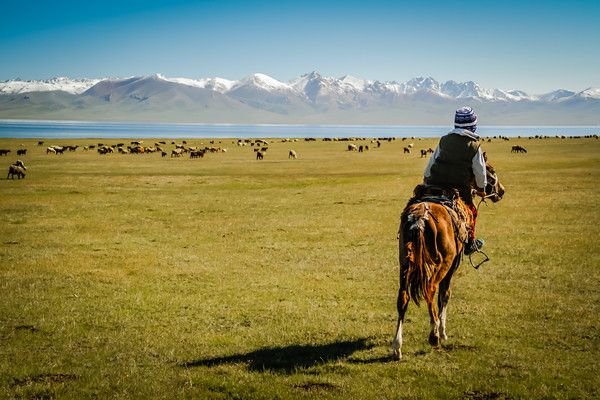
Life in a summer yurt still starts before sunrise. Women make breakfast, milk the cows and mares and pack food for the men who take the animals to graze. Children learn to ride almost as soon as they can walk. In the evening everyone gathers around the stove for tea, bread and stories.
Sleeping in a yurt
A night in a yurt camp is one of the highlights of any trip. You sleep on thick felt mattresses under heavy blankets; most camps have a stove, and the hosts light it for you in the evening. Nights are cold even in August, so bring warm layers.
The best places for yurt stays are the shores of Song-Kol lake, the Tash-Rabat valley and the summer pastures around Kochkor and Issyk-Kul. See our tours with yurt nights, and read about Kyrgyz food — you’ll eat a lot of it in the yurt.