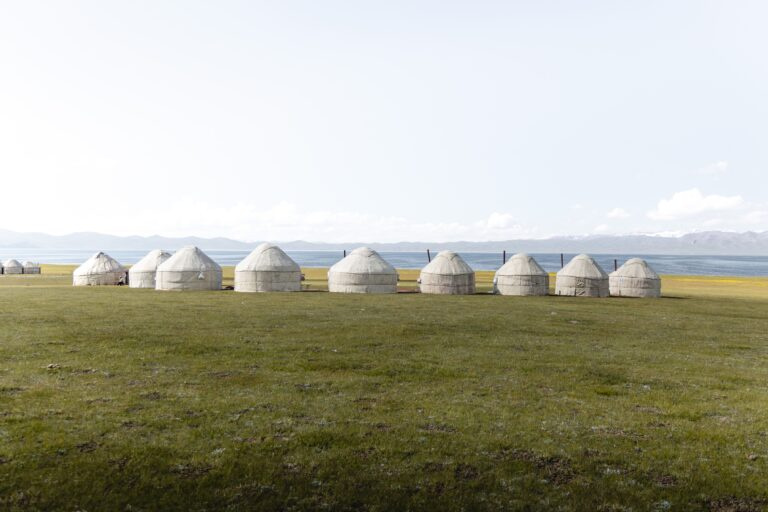

Kyrgyz crafts were born in the yurt. Everything a nomad family owned had to be useful, light and easy to carry — and it was made beautiful too. Ornament and colour are the language of Kyrgyz craft: patterns of ram’s horns, plants and geometric shapes decorate everything from a baby’s cradle to a horse’s saddle.
Shyrdak — the mosaic felt carpet
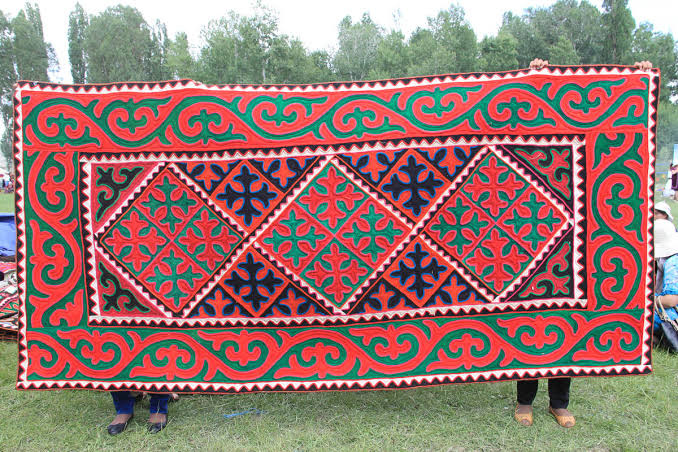
The shyrdak is the main carpet of the Kyrgyz home and the best-known Kyrgyz craft. It is made from the wool of sheep shorn in autumn, felted into thick, dense sheets and dyed in strong colours.
The technique is clever: two pieces of felt in contrasting colours are laid on top of each other, a pattern is cut through both, and the pieces are swapped and sewn together — so each colour becomes both pattern and background. The seams are then outlined with a twisted cord. The result is bold and graphic: red with blue, brown with orange, white with brown.
A shyrdak is usually rectangular — twice as long as it is wide — with a central field and a border. Older carpets show circles; later ones, the famous ram’s horn motifs in diamond frames. A good shyrdak lasts for generations.
Ala-kiyiz — the ‘colourful felt’
Ala-kiyiz is made differently: pieces of loose coloured wool are laid out in a pattern on a base of undyed wool and then rolled and pressed together. The pattern melts into the felt, with soft, blurred edges that look almost like watercolour.
In 2012 UNESCO added the art of Kyrgyz felt carpets, ala-kiyiz and shyrdak, to its List of Intangible Cultural Heritage in Need of Urgent Safeguarding — fewer young people are learning the craft, which is why buying directly from the makers matters.
Chiy — mats of steppe grass
Chiy is a tall, tough steppe grass harvested in September. Each stem is wrapped by hand in coloured wool and then the stems are tied together into a mat, so the craftswoman has to keep the whole pattern in her head. Chiy mats are wrapped around the yurt walls, used as windbreaks and laid under felt carpets to keep them dry.
Embroidery
Embroidery is the oldest and best-loved women’s craft, with flowing plant motifs — leaves, branches, flowers and rosettes. Skilled embroiderers work without drawing the pattern first.
- Tush-kiyiz — a large embroidered wall hanging, hung behind the bed or the place of honour. Often made for a bride’s dowry.
- Ayak-kap — embroidered bags for dishes and small things, with a triangular flap and fringes.
- Tekche — a hanging shelf-panel of velvet or leather.
- Kurak — patchwork of colourful pieces of cloth in geometric patterns.
The kalpak
The tall white felt hat, ak kalpak, is the symbol of the Kyrgyz man. Its shape, pattern and trim once told a man’s age and status. In 2019 the craft of making and wearing the ak kalpak was added to UNESCO’s Intangible Cultural Heritage list, and every 5 March Kyrgyzstan celebrates Kalpak Day. A kalpak makes a great souvenir — just remember never to put it on the floor.
Leather, horse gear and wood
Nomads made bottles and bowls for milk from smoked leather, cases for drinking bowls, belts and whips. The saddle and harness of a good horse were works of art, decorated with silver plates, embossed leather and coloured felt — a full set of horse gear was often part of a bride’s dowry. Woodcarvers decorated chests, bowls, music instruments, cradles and the doors of the yurt with circles, rosettes and paired horn-like curls.
Silver jewellery
For the Kyrgyz, silver was more than decoration: the word ak, ‘white’, also means truth and purity, and silver was believed to protect from evil. Jewellers made rings, open bracelets, plait pendants (chach uchtuk), large chest ornaments and decorative buttons, and decorated men’s belts and harness. Girls and young women wore the most jewellery, and many families still keep pieces handed down for generations.
Traditional dress
Nomad clothing was made for a mountain climate: quilted coats (chapan), sheepskin coats and fur coats (ichik), and felt cloaks for shepherds. Married women once wore a huge white turban, the elechek, and a velvet wrap skirt, the beldemchi, which kept them warm in the saddle. Young girls wore a round cap with a fur trim, the tebetei. Today you will see traditional dress mostly at weddings, festivals and on national holidays.
How to buy felt
- Buy from the makers if you can — the women’s cooperatives of Kochkor are famous for shyrdaks; there are also good craft shops and cooperatives in Bishkek and Karakol.
- Check the stitching: on a hand-made shyrdak the cord outlines are sewn on evenly by hand all over the carpet.
- Natural dyes cost more than chemical ones; ask what was used.
- A shyrdak is heavy — ask the shop about shipping, or choose smaller pieces such as cushion covers, slippers and wall panels.
On several of our tours you visit felt makers in Kochkor and can try making a piece of felt yourself. Read also: the Kyrgyz yurt.