

Stories
Tash-Rabat: The Legend of the Caravanserai in the Mountains
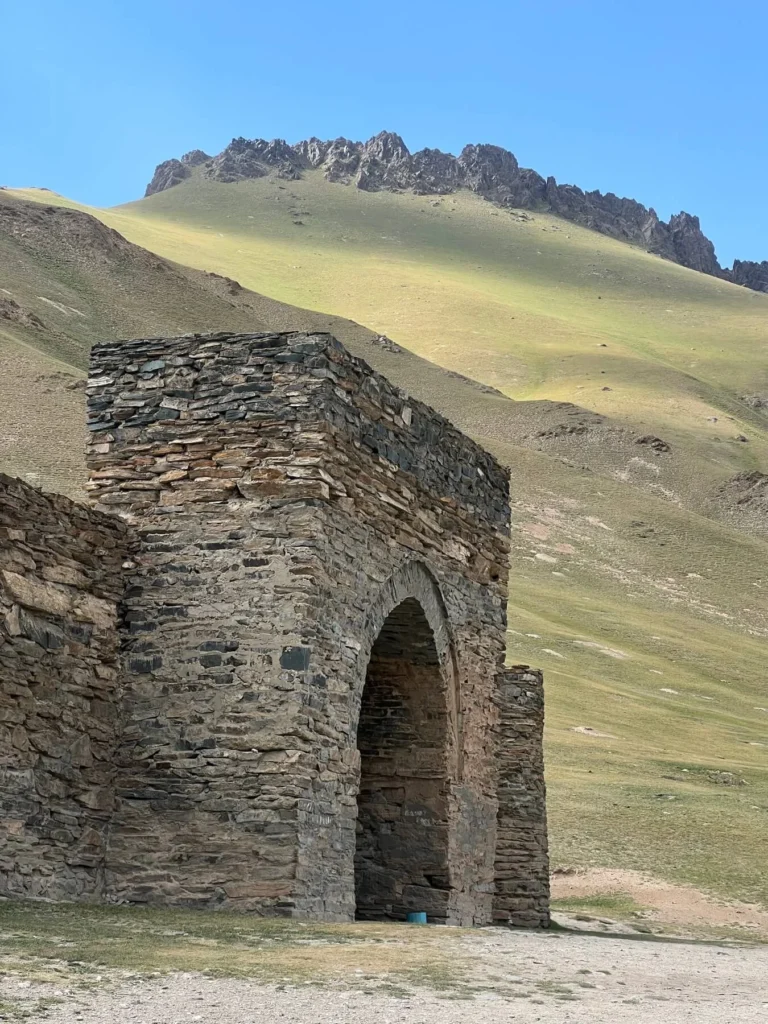
High in a quiet valley of the At-Bashy mountains, at about 3,500 metres, stands a building that seems to grow out of the hillside: Tash-Rabat, the ‘stone fortress’. It is a caravanserai — an inn for Silk Road merchants — with thick stone walls, a domed central hall and some thirty small rooms. For centuries caravans travelling between the Chui valley and Kashgar rested here before or after the Torugart pass. Historians still debate how old it is — it may have been a monastery before it became an inn. The legend has its own answer.
The khan’s test
Long ago there lived a powerful khan with two sons. He loved them both and could not decide which one should rule after him. One day he called the elder son.
I am old, and soon the khanate will be yours. So that I can die in peace, show me what you are capable of.
Some time later the son returned. ‘Our khanate is great and rich,’ he said, ‘but it could be richer. I would send caravans with our goods to foreign lands, and invite foreign merchants to come to us. Let the caravans cross our land too. And I would build a caravanserai where everyone will find shelter and hospitality.’
‘So be it,’ said the khan.
A house for a thousand years
Soon the old khan died. The elder son honoured his father, travelled with a caravan to distant lands, and on his return began to prepare for the merchants. He wanted to build a caravanserai that would stand for a thousand years. He gathered the most famous masters from every corner of the land, and for many years they built in stone.
When it was finished, everyone who saw it was amazed: its walls were as thick as any fortress, its rooms spacious, and its great domed hall had three vaulted niches. The fame of Tash-Rabat spread far, and many merchants left other roads just to enjoy its hospitality. Every year the khan grew richer, and his people prospered too.
The robber khan
But the good khan died, and his younger brother took the throne. He dreamed of another kind of glory. He gathered a band of warriors, attacked the peaceful caravans and stored the loot in the caravanserai.
At last the neighbouring khans marched against him. He shut himself and his warriors inside Tash-Rabat, but even its thick stone walls could not save him. His warriors fell, he died, and the caravanserai was left in ruins — a silent reproach to the robber khan.
Tash-Rabat today
The caravanserai has been restored and you can walk through its cool, dim rooms by torchlight. The valley around it is wonderful: yurt camps on green meadows, horses grazing by the stream, and hikes or rides up to a pass with views over Chatyr-Kol lake towards China. Spending a night in a yurt here, under an enormous sky, is one of the highlights of a Silk Road trip.
Visit
Tash-Rabat lies about 2 hours from Naryn, off the road to the Torugart pass. Read also: The Kyrgyz yurt and a short history of Kyrgyzstan.